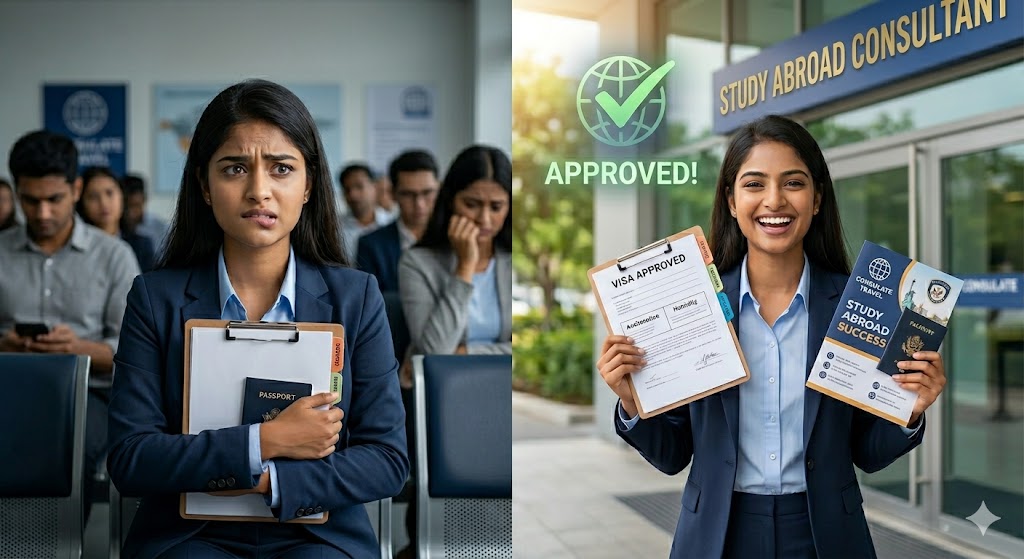
Picture this: You’ve spent months agonizing over your SOP, hunting down letters of recommendation, and refreshing your email inbox until your thumb cramped. Finally, the golden ticket arrives—your university acceptance letter! You are officially going to study abroad. But just as you start mentally packing your bags, a new hurdle appears on the horizon, casting a long, intimidating shadow over your study abroad journey: the dreaded Visa Interview.
If your palms are sweating just reading those two words, take a deep breath. You are not alone. For almost every international student, sitting across from a visa officer feels like the ultimate boss battle. Will they reject you? Will you say the wrong thing? What if you forget your own name?
Let’s hit the pause button in panic. The truth is, a student visa application isn’t designed to trick you. Visa officers aren’t standing at the gates trying to keep you out; they are simply doing their jobs—verifying that you are a genuine student with a legitimate plan and the funds to support yourself.
In this ultimate guide, we are taking you from anxiety to approval. We will break down the psychology of the interview, dissect the most frequently asked questions, and give you the insider visa interview tips you need to walk into that consulate with absolute confidence.
Part 1: The Mindset Shift – What is the Visa Officer Actually Looking For?
Before we dive into the specific questions, you need to understand the rules of the game. Whether you are aiming for an F1 visa interview for the USA, a credibility interview for your UK student visa, or submitting your biometrics for a Schengen student visa, every visa officer across the globe is essentially looking to answer three core questions about you:
- Are you a genuine student? (Do you actually want to study, or are you just using the visa as a backdoor ticket to work and live in their country?)
- Can you afford it? (Do you or your sponsors have the liquid cash to pay for your tuition and living expenses without resorting to illegal employment?)
- Will you return home? (Do you have strong ties to your home country that will compel you to leave once your studies are completed?)
If your answers and your documents satisfy these three pillars, your visa approval is practically guaranteed.
Part 2: The “Big Four” FAQs (and How to Crush Them)
Visa officers are short on time. They conduct dozens of interviews daily, which means your interview might last anywhere from a brief two minutes to a slightly more intense ten minutes. You need to be concise, confident, and specific. Let’s look at the four questions that form the backbone of almost every visa interview preparation.
1. “Why did you choose this specific country for your studies?”
The Trap: Giving a generic answer like, “The USA has good education,” or “Germany is beautiful,” or “Australia has a great lifestyle.” The Reality: The officer knows their country is great. They want to know why it is great for your specific career trajectory.
How to Answer: Focus on academic infrastructure, industry alignment, and specific opportunities that your home country lacks.
- Bad Answer: “I want to study in the UK because it is a developed country and I love London.”
- Winning Answer: “While researching my Master’s in Data Science, I found that the UK offers a highly intensive one-year program structure that gets me into the workforce faster. Furthermore, the UK is a global hub for fintech, which aligns perfectly with my goal to work in financial analytics upon returning home.”
2. “Why did you choose this university, and why this specific course?”
The Trap: Saying your consultancy chose it for you, or mentioning that the university was cheap or easy to get into. The Reality: You need to prove you did your homework. A genuine student researches their investment.
How to Answer: Name-drop professors, specific modules, research labs, or alumni networks. Compare it to other universities you applied to.
- Bad Answer: “It is a highly ranked university and my friend goes there.”
- Winning Answer: “I applied to three universities in Ireland, but I ultimately chose Trinity College because of their specific module on Sustainable Engineering. I was also very impressed by Dr. Smith’s recent publications on renewable energy, and I hope to contribute to his research lab. It aligns perfectly with the current green energy initiatives happening back in my home country.”
3. “Who is sponsoring your education, and what do they do?”
The Trap: Getting flustered about money or giving vague details about your family’s finances. The Reality: Education abroad in places like the USA, New Zealand, or France is expensive. The officer needs absolute assurance that you won’t drop out due to lack of funds.
How to Answer: Be direct, precise, and have your financial documents ready to hand over. Know the exact figures of your tuition and living expenses.
- Bad Answer: “My dad is paying for it. He has a business.”
- Winning Answer: “My education is being fully sponsored by my father and an education loan. My father owns a textile manufacturing company with an annual turnover of $X, and we have liquid savings of $Y. I also have an approved education loan of $Z from [Bank Name]. I have the financial summaries right here if you would like to see them.”
4. “What are your plans after graduation?”
The Trap: Saying you want to settle down, find a job, and live forever in their country. (Even if the country offers a post-study work visa, your primary visa type is a non-immigrant or temporary visa). The Reality: You must demonstrate “home ties.” You need to show that your degree is an investment that will pay off back home.
How to Answer: Show ambition and a clear career trajectory in your home country. Mention specific companies or roles.
- Bad Answer: “I hope to find a good job in New York and settle there.”
- Winning Answer: “After completing my degree and gaining some practical exposure, I plan to return to my home country. The healthcare management sector here is growing by 15% annually. My goal is to take up a role as a Hospital Administrator at top-tier facilities like [Name of local hospital], where international expertise is highly valued and compensated.”
Part 3: Destination-Specific Quirks You Need to Know
A study abroad visa isn’t a one-size-fits-all process. Depending on where your flight is landing, the consulate will have different priorities. Working with Eleevate Overseas can help you navigate these regional nuances, but here is a quick cheat sheet:
The United States (F-1 Visa)
The US interview is notoriously rapid-fire, often lasting just 2 to 3 minutes. The absolute biggest hurdle here is Section 214(b) of the Immigration and Nationality Act, which legally presumes every applicant is an intending immigrant. Your only job is to prove you are not. Focus heavily on your ties to your home country—family businesses, property, or a highly specific career plan back home.
The United Kingdom (Tier 4 / Student Route)
The UK often relies on a “Credibility Interview” conducted via video link. They care deeply about your academic progression. If you are going for a Master’s, how does it connect to your Bachelor’s? They will also drill you on the exact location of your campus, the cost of your accommodation, and your specific modules. Ignorance of your own curriculum is a massive red flag here.
Europe (Schengen Zone: Germany, France, Italy, Austria, Hungary)
If you are heading to the heart of Europe, the process is often highly document-centric. For a Schengen student visa, the interview might be shorter, but the paperwork must be flawless. Germany, for instance, requires a Blocked Account (Sperrkonto) to prove your finances. They will also test your academic readiness. If your course is in German or French, expect the officer to test your language proficiency on the spot!
Australia, New Zealand, and Ireland
These countries place a massive emphasis on the Genuine Student (GS) or Genuine Temporary Entrant (GTE) requirements. You usually submit a detailed statement explaining your intentions before the interview stage. If you are called for an interview, they will cross-examine what you wrote in your GS/GTE statement. Consistency is your best friend here.
Dubai
Studying in Dubai is incredibly popular due to its seamless visa process. Usually, your university acts as your sponsor, making the visa process much smoother and often avoiding a rigorous traditional interview. However, you still need to be prepared to articulate your academic goals and how a degree from a UAE institution fits your global career plan.
Part 4: The Ultimate Interview Day Checklist
Being prepared isn’t just about what you say; it is about what you bring. Having your documents neatly organized shows the officer that you are responsible and serious about your international student visa.
The Essentials:
- Your Passport: Must be valid for at least six months beyond your intended stay.
- Visa Application Confirmation Page & Receipt: Proof that you paid the fees.
- University Acceptance Documents: The I-20 (for the US), CAS (for the UK), or official Letters of Acceptance for Europe and Oceania.
- Financial Evidence: Bank statements (last 3-6 months), education loan sanction letters, scholarship award letters, and sponsor income tax returns.
- Academic Transcripts: Original degree certificates, mark sheets, and standardized test scores (IELTS, TOEFL, GRE, GMAT).
Pro-Tip: Do not shove everything into a chaotic plastic bag. Use a harmonium folder with clear tabs (e.g., “Academics,” “Financials,” “Identity”). When the officer asks for your bank statement, you want to pull it out smoothly in two seconds flat, not spend three minutes rummaging through papers while sweating nervously.
Part 5: Body Language, Etiquette, and the Unspoken Rules
You are being evaluated the moment you walk up to the window. Your body language speaks before you even say “Good morning.”
- Dress the Part: You don’t need to wear a three-piece tuxedo, but dress as if you are going to a professional job interview. Business casual is the sweet spot. A crisp shirt, neat trousers, and a tidy appearance show respect for the process.
- Maintain Eye Contact: When you answer, look at the officer, not at the ceiling, not at your shoes, and not at the translator (if you are using one). Eye contact projects honesty and confidence.
- Listen Carefully, Answer Directly: Do not memorize a script. If the officer asks, “What is your father’s annual income?” do not reply with a five-minute monologue about how hard your father works. Say, “His annual income is X.” Keep it brief. Let them ask follow-up questions if they want more details.
- Embrace the Silence: Visa officers are often typing your answers into their computers while you speak. Sometimes there will be 10 to 15 seconds of awkward silence. Do not babble to fill the silence. Wait patiently for their next question.
- Stay Calm if Things Go Off-Script: Sometimes officers ask curveball questions to test your composure (“What is your favorite movie?” or “Why shouldn’t I reject your visa?”). Smile, take a breath, and answer naturally. They are just testing your English proficiency and ability to think on your feet.
FAQs: Mastering Your Visa Interview
Q1: What is the most common reason for rejection in a Visa Interview?
Most rejections fall under “Potential Immigrant” intent or “Insufficient Funds.” If the officer feels you don’t have strong ties to your home country or if your financial documents are unclear, they may deny the application. This is why proving your “home ties” is the most critical part of your Visa Interview preparation.
Q2: How early should I start preparing for my Visa Interview?
The moment you receive your offer letter! Don’t wait for the last minute. At Eleevate Overseas, we recommend starting your Visa Interview coaching at least 3–4 weeks before your appointment to allow time for mock sessions and document organization.
Q3: Should I memorize my answers for the Visa Interview?
Absolutely not. Visa officers are trained to spot rehearsed scripts. Instead of memorizing words, internalize your “Why.” Know your course modules, your university’s strengths, and your career roadmap by heart. If you sound like a robot during your Visa Interview, it raises a red flag regarding your authenticity as a student.
Q4: Can I bring someone with me to the Visa Interview?
In almost all cases, no. The Visa Interview is a solo mission. It is designed to test your English proficiency, your academic intent, and your confidence. Bringing a parent or consultant isn’t permitted, as the officer needs to see that you are independent enough to manage your life and studies abroad.
Q5: What should I do if I am asked a question I don’t know the answer to?
Don’t panic or lie. If you are asked a highly specific detail—like the exact square footage of your campus—and you don’t know, it’s better to be honest. However, you should know the “big” details. If you don’t know your tuition fees or your course start date during the Visa Interview, it signals a lack of genuine interest in your education.
Conclusion
Securing an international student visa is the final, crucial puzzle piece in your study abroad journey. It is entirely normal to feel anxious, but remember that preparation is the ultimate antidote to fear.
By understanding the psychology of the visa officer, mastering your answers regarding your academic and financial intent, and presenting yourself as a confident, genuine student, you transform the interview from an interrogation into a simple conversation.
We take the guesswork out of the entire process with flawless document preparation, expert guidance, and realistic mock interviews tailored to your specific destination. Let us handle the stress and heavy lifting so you can focus on what really matters: packing your bags! Reach out to Eleevate Overseas today, and let us prepare you for the exact moment the officer says those four magical words: “Your visa is approved.”