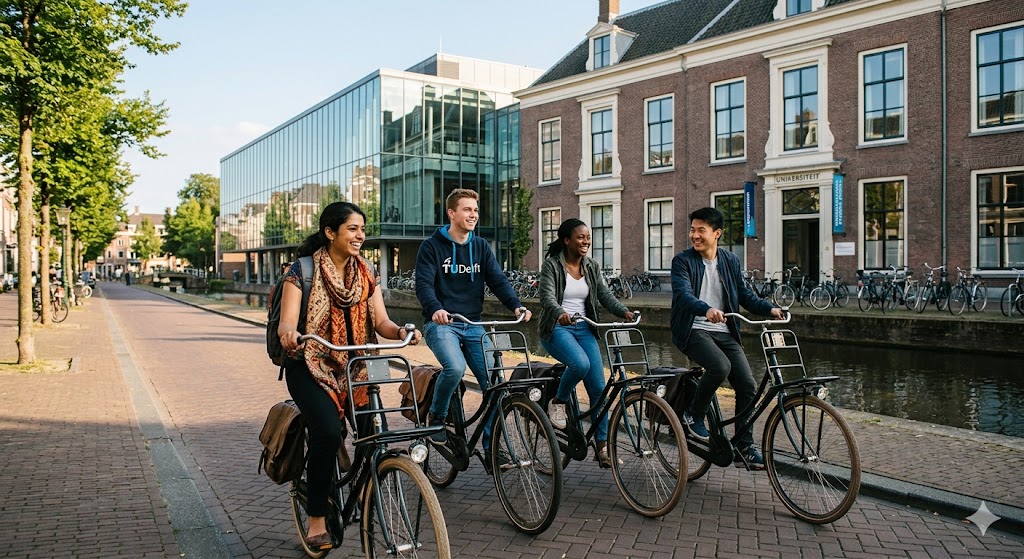
Did you know that the country that invented Wi-Fi, Bluetooth, and the artificial heart is the exact same country where a third of the landmass sits below sea level? The Dutch do not just survive the future; they engineer it. If you are an international student aiming to be part of this relentless culture of innovation, exploring Universities in the Netherlands is your first step toward a completely transformative global career.
For ambitious minds—especially those coming from the highly competitive academic landscape in India—studying abroad is not just about getting a degree; it is about calculating the best possible return on investment (ROI) for your future. You want to know exactly what happens inside the lecture halls, which university aligns with your career goals, and how you will navigate the famed Dutch student lifestyle.
The Academic Titans: A Deep Dive into Dutch Universities
We need to talk about the institutions themselves, because the higher education system here operates on a radically different level. Unlike countries where there is a steep drop-off in quality after the top three colleges, the Dutch system is fiercely egalitarian. Almost all of their research universities rank in the top 2% worldwide.
You aren’t just choosing a brand name; you are choosing a specific micro-culture and a direct pipeline to specific industries. Here is a no-nonsense breakdown of the top universities and exactly what life looks like on their campuses.
1. Delft University of Technology (TU Delft)
- The Global Reputation: Think of TU Delft as the MIT of Europe. It is a global heavyweight in Civil Engineering, Architecture, Aerospace, and Mechanical Engineering.
- The Campus Reality: The campus is larger than downtown Delft itself—a sprawling mini-city dedicated to technology. It is intensely rigorous. You will likely spend your time in “Dream Teams”—student-led, fully funded groups that build solar-powered race cars (the Nuna project) or hyperloop pods.
- Who Should Go Here: Hardcore innovators, coders, and engineers who thrive under pressure. If you graduate from Delft, global tech giants and engineering firms will actively hunt for your resume.
2. University of Amsterdam (UvA)
- The Global Reputation: Consistently ranked as the #1 university in the world for Communication and Media Studies, and a powerhouse for Social Sciences, AI, and Business.
- The Campus Reality: UvA does not have a traditional, enclosed campus. Its faculties are woven directly into the historic heart of Amsterdam. You might study in a 17th-century canal house in the morning and attend a seminar in a hyper-modern glass building at the Amsterdam Science Park in the afternoon.
- Who Should Go Here: Students who want a fast-paced, deeply cosmopolitan city experience. You are sharing the streets with international expats, global NGOs, and corporate headquarters.
3. Erasmus University Rotterdam (EUR)
- The Global Reputation: The absolute go-to for Corporate Business, Economics, and Management. It houses the world-renowned Rotterdam School of Management (RSM).
- The Campus Reality: Rotterdam is a city of sleek skyscrapers, and the EUR campus reflects this. The vibe here is sharply dressed, highly ambitious, and “hustle-driven.” EUR has incredibly strong, direct ties with multinational companies like Unilever, Shell, and ING.
- Who Should Go Here: Future CEOs, finance analysts, and supply chain experts. If your goal is to climb the corporate ladder quickly and network with C-suite executives, EUR is your launchpad.
4. Eindhoven University of Technology (TU/e)
- The Global Reputation: The beating heart of the European tech industry, excelling in Electrical Engineering, Computer Science, and Industrial Design.
- The Campus Reality: TU/e is located in the “Brainport” region, universally acknowledged as Europe’s Silicon Valley. What makes TU/e mind-blowing is its integration with industry. The university shares research facilities with local tech titans like ASML (the most critical semiconductor company on earth) and Philips.
- Who Should Go Here: Tech students who want a job immediately upon graduation. The pipeline from TU/e lecture halls to ASML and NXP Semiconductors is direct and highly lucrative.
5. Wageningen University & Research (WUR)
- The Global Reputation: It is literally ranked the #1 university in the world for Agriculture, Forestry, and Environmental Science.
- The Campus Reality: Located in the “Food Valley,” Wageningen is a smaller, incredibly tight-knit, fiercely green city. The international community is massive, but the focus is hyper-specific. Campus life revolves around sustainability projects, climate change mitigation, and food tech innovations.
- Who Should Go Here: Students passionate about solving the world’s most pressing environmental and agricultural crises.
6. University of Groningen (RUG)
- The Global Reputation: A comprehensive top-100 university known for its cutting-edge research in Energy, Chemistry, and Astronomy.
- The Campus Reality: Groningen is the ultimate student city. With the youngest average population in the Netherlands, the city belongs to the students. The campus facilities are state-of-the-art, particularly the Zernike Campus for exact sciences.
- Who Should Go Here: Students who want a traditional, vibrant, hyper-social university life combined with top-tier academic rigor.
7. Maastricht University (UM)
- The Global Reputation: The youngest top-tier university, famous for its International Law, Medicine, and Business programs.
- The Campus Reality: Located in the deep south, Maastricht feels more like Belgium or France. It is highly international and famous for pioneering the Problem-Based Learning (PBL) method (more on this below).
- Who Should Go Here: Independent thinkers who hate traditional lectures and prefer debating real-world problems in small groups.
Inside the Classroom: The Dutch Pedagogy
If you are used to large lecture halls where a professor dictates notes for you to memorize, the Dutch system will be a massive culture shock. Here is what you will actually experience:
- Problem-Based Learning (PBL): Dutch universities prioritize PBL. You are placed in tutorial groups of 10–15 students. You are given a real-world case study (e.g., a failing supply chain or a complex legal loophole), and you must research, debate, and solve it together. You do the heavy lifting; the professor merely guides the discussion.
- The Flat Hierarchy: You will call your professors by their first names. Deference to authority is replaced by respect for logical arguments. You are expected to challenge your professors, debate their theories, and speak up. Silence is not seen as respect; it is seen as a lack of preparation.
- The Infamous Grading System: The Dutch grade on a 1-to-10 scale. A 5.5 is a pass. If you are a straight-A student back in India, brace yourself: a 10 is almost never awarded. There is a saying here: “A 10 is for God, a 9 is for the professor, and an 8 is for the brilliant student.” Earning a 7.5 or an 8 is a massive achievement.
English-Taught Programs in the Netherlands: A Global Advantage
A major anxiety for international students is the language barrier. Do you need to speak Dutch to excel academically? Absolutely not.
The Netherlands was the first non-English-speaking country in Europe to offer higher education in English. Today, there are over 2,000 English-taught programs in the Netherlands, covering everything from specialized Master’s degrees in AI to Bachelor’s degrees in International Business. Furthermore, the Dutch are ranked as the best non-native English speakers in the world. You can comfortably study, research, and live your daily life entirely in English.
(Pro Mentor Tip: While you don’t need Dutch to survive, taking a basic Dutch course offered by your university will give you a massive edge when applying for local internships).
Student Life in the Netherlands: Beyond the Books
Student life in the Netherlands is vibrant, deeply social, and highly structured. Here is how your downtime will look:
- The Cycling Culture: You will bike everywhere. To the library, to the grocery store, to the pub. Bicycles outnumber people. It keeps you fit, saves you thousands of Euros in transport, and instantly integrates you into the Dutch way of life.
- Gezelligheid: You will quickly learn this untranslatable Dutch word. It means a vibe of coziness, togetherness, and warmth. After a hard day in the lab, you will gather with classmates for a borrel (after-work drinks and snacks like bitterballen) at the campus pub.
- Study vs. Student Associations: You must join a Study Association (linked to your faculty for book discounts, networking, and tutoring) and a Student Association (for sports, socializing, and parties). For Indian students, almost every major university has an active Indian Student Association (ISA) to help you celebrate Diwali or find the best local spices.
Cost of Living in the Netherlands
Let’s talk numbers. Western Europe is an investment, but the cost of living in the Netherlands offers exceptional value when compared to the tuition fees of the USA or Australia.
Here is a realistic monthly breakdown for an international student:
- Accommodation: €600 – €1,100 (Amsterdam and Utrecht are significantly more expensive than Enschede or Groningen).
- Groceries & Food: €250 – €350 (Shop at Aldi, Lidl, and local open-air markets to save money).
- Health Insurance: €120 – €140 (Mandatory, but if you work part-time, you can claim a government allowance called Zorgtoeslag to get most of this refunded).
- Transport & Misc: €150 – €250 (Assuming you buy a second-hand bike and cook most of your meals).
Estimated Total: €1,120 – €1,840 per month.
The Housing Warning: The Netherlands is facing a severe housing crisis. Do not wait until your visa arrives to look for a room. The minute you receive your university acceptance, start hunting on platforms like Kamernet or SSH, or take the university-provided housing if offered.
Part-Time Jobs in the Netherlands: Earning While Studying
To offset living costs, finding part-time jobs in the Netherlands is a common route for international students.
If you hold a non-EU/EEA passport, you are legally permitted to work a maximum of 16 hours a week during the academic year, OR full-time during the summer months (June to August).
You will need your employer to apply for a Tewerkstellingsvergunning (TWV – work permit). Popular jobs for students who don’t speak Dutch include food delivery (Thuisbezorgd, UberEats), warehouse logistics, campus cafes, and university research assistant roles. The minimum wage is highly regulated, and you can expect to earn around €13 to €15 per hour depending on your age.
The Ultimate ROI: Post-Study Work Opportunities Netherlands
For most international students, the ultimate goal is to secure global work experience. The post-study work opportunities Netherlands provides are among the most generous and straightforward in the world.
Enter the Orientation Year Visa (Zoekjaar).
Upon graduating from a recognized Dutch university, you have up to three years to apply for this visa. Once activated, it grants you exactly one year to live in the Netherlands with unrestricted access to the labor market. You do not need a work permit, and you can take on internships, freelance work, or full-time roles while hunting for a permanent corporate sponsor.
The Dutch economy is desperately seeking highly skilled international talent, particularly in:
- Tech and IT (Eindhoven and Amsterdam)
- Engineering and Renewable Energy (Delft, Twente)
- Logistics and Supply Chain (Rotterdam)
- Finance and Analytics (Amsterdam)
Once you secure a permanent contract, your employer will transition you to a Highly Educated Migrant visa, setting you firmly on the path to long-term residency. With your Netherlands student visa transitioning smoothly into a career pathway, the ROI of a Dutch education is unmatched.
FAQs
1. How much does it cost to study and live at Universities in the Netherlands?
For international students, the realistic monthly cost of living ranges from €1,120 to €1,840. Location heavily influences your budget; attending Universities in the Netherlands in major cities like Amsterdam or Utrecht will cost significantly more in accommodation than studying in regional hubs like Groningen or Enschede.
2. Are there English-taught programs at Universities in the Netherlands?
Yes. There are over 2,000 English-taught programs available across the country. You can comfortably pursue Bachelor’s or Master’s degrees at top Universities in the Netherlands—and navigate your daily life—entirely in English, without needing to speak Dutch.
3. Can international students stay and work after graduating from Universities in the Netherlands?
Absolutely. Graduates from Universities in the Netherlands are eligible for the Orientation Year Visa (Zoekjaar). This highly flexible visa allows you to stay in the country for one full year with unrestricted access to the labor market, giving you time to freelance, intern, or secure a permanent corporate sponsor.
4. What is the grading and teaching style like at Universities in the Netherlands?
The academic culture relies heavily on Problem-Based Learning (PBL). Instead of massive lectures, you will work in small groups of 10–15 students to solve real-world cases. Additionally, Universities in the Netherlands use a notoriously strict 1-to-10 grading scale; a 5.5 is a pass, and scoring an 8 is considered a massive achievement.
5. Can I work part-time while attending Universities in the Netherlands?
Yes. Non-EU/EEA students enrolled at Universities in the Netherlands are legally permitted to work up to 16 hours a week during the academic year, or full-time during the summer months (June to August). You can expect to earn around €13 to €15 per hour in common roles like logistics, food delivery, or campus jobs.
Final Verdict: Is It Worth It?
Studying at a Dutch university is not a walk in the park. The grading is tough, the professors demand excellence, the housing market is tight, and you will inevitably get soaked while cycling against the wind in November.
But when you study in the Netherlands, you are buying into a system that forces you to become independent, critically sharp, and globally competitive. You will graduate not just with a piece of paper, but with real-world problem-solving skills, an international network, and direct access to Europe’s most innovative job market.Are you ready to trade traditional lecture halls for high-tech innovation hubs? The Dutch universities are looking for the next generation of global leaders. Don’t leave your global ROI to chance. Connect with Eleevate Overseas today for a free, personalized profile evaluation, and let’s start mapping out your journey to the Netherlands!