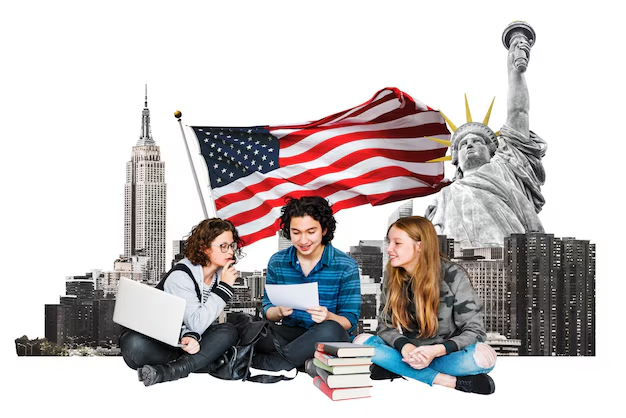
If you’re planning to study in the USA in 2026, you’re stepping into a country that still attracts more international students than any other – nearly 1.2 million in 2024–25, with India now the No. 1 source country. But the landscape is changing: visa rules are under review, competition for jobs is intense.
Why the USA Still Attracts So Many Students
For younger students, study in the USA remains a powerful mix of brand value, research strength, and post-study work opportunities.
- The US hosts about 1.18 million international students, around 6% of total higher education enrolments, confirming it as the world’s top study destination.
- India now accounts for roughly 31% of all international students in the US, overtaking China and showing how strongly Indian students still bet on America for STEM, business, and research degrees.
- Top US universities dominate global rankings; Times Higher Education’s 2026 list continues to place institutions like MIT, Stanford, Harvard, Caltech, and Princeton in the very top band for teaching, research, and global impact.
For many Indian families, a US degree still signals credibility to employers, especially for tech, analytics, finance, and research roles in India, the Middle East, and Europe.
New USA Student Visa Rules 2026: What’s Actually Changing?
There’s a lot of noise around “new USA student visa rules 2026,” so it’s important to separate rumours from confirmed updates.
F‑1 visa basics (what’s stable)
- F‑1 remains the primary visa for academic study in the USA; it allows full-time study plus limited on-campus work and options like CPT and OPT for practical training.
- J‑1 (exchange/visiting students) and M‑1 (vocational) categories continue for specific program types, with slightly different work and funding rules.
2026 developments and proposals
- Tech and education media in early 2026 emphasise that most proposed changes to F‑1, J‑1, and M‑1 rules are still under discussion; students are advised to track DHS/USCIS announcements rather than viral social media takes.
- The US Department of Homeland Security has announced increased premium processing fees from March 2026 for certain F‑1-related applications (including some OPT categories), which will make “fast-track” processing more expensive but not mandatory.
- Policy debates continue around Optional Practical Training; some reporting in late 2025 highlighted a proposed rule from the Trump administration that could restrict or reshape OPT, especially for certain degree levels, although the core framework remains in place as of early 2026.
For students applying now, the practical takeaway is: the F‑1 pathway is open, OPT/STEM OPT still exist, but timelines, costs (like premium processing), and compliance checks are tightening slightly.
OPT and STEM OPT Updates 2026: Your Realistic Work Window
If you’re reading about “OPT and STEM OPT updates 2026,” you’re really asking: “How long can I legally work in the US after graduation, and how risky is it?”
Standard OPT
- Standard post-completion OPT offers up to 12 months of work authorization for eligible F‑1 students in jobs directly related to their field of study.
- Students must apply before their program ends or shortly after; missing the deadline can mean losing the entire opportunity for US work experience.
STEM OPT (24‑month extension)
- STEM OPT remains a 24‑month extension for students with degrees on the DHS STEM Designated Degree Program List, creating a total of up to 36 months (1 year OPT + 2 years STEM OPT).
- To qualify, you must: hold an eligible STEM degree, work for an E‑Verify employer, be in a role directly connected to your major, and submit a complete application before your initial OPT ends.
- 2026 guidance anticipates tighter oversight: more robust employer reporting, closer scrutiny of training plans (Form I‑983), and careful evaluation of interdisciplinary or borderline programs claiming STEM eligibility.
Why this matters for ROI
- Many employers explicitly prefer candidates who can stay beyond a single year; the 36‑month window offered to STEM graduates is a big reason why STEM programs often deliver better ROI than non‑STEM in the US.
- In practice, this gives you 2–3 hiring cycles to move from “entry-level hire on OPT” to “candidate for H‑1B or another long-term status,” which can be critical in a competitive job market.
Skill Shortages in the USA: Where the Jobs Really Are
If you’re thinking about USA job opportunities for graduates, you need to align your program choice with current skill shortages.
High-Demand Courses in the USA
Reports on US labour shortages in 2025–26 show persistent gaps in several key industries:
- Technology & IT: Software engineering, data science, AI, cybersecurity, and cloud roles remain in demand despite periodic layoffs; companies still struggle to find specialized tech talent.
- Healthcare & Biotech: There are critical shortages in nursing, healthcare administration, biotech research, pharmaceuticals, and public health, particularly as the population ages.
- Engineering & Infrastructure: Civil, mechanical, electrical, and construction-related roles are needed to support infrastructure and green energy projects.
- Business, Finance & Analytics: Employers continue to hire in risk management, financial analytics, supply chain, and business intelligence, especially for graduates with strong quantitative and data skills.
- Hospitality, Education & Services: Ongoing gaps in education, hospitality, manufacturing, and logistics create additional openings, though not all are ideal for F‑1 graduates in terms of sponsorship.
What this means for your course choice
- Degrees in STEM, healthcare, analytics, and high‑tech domains are best positioned to leverage OPT/STEM OPT and convert into sponsored roles in shortage sectors.
- Generalist degrees without a clear technical or professional edge may struggle to compete unless you build strong work experience, networking, and niche skills alongside your studies.
Top USA Universities for International Students in 2026
Rankings still matter, but as an international student, you need to balance brand, cost, support, and employability.
The Research Powerhouses
Times Higher Education 2026 and meta-rankings continue to show US universities at the very top globally. MIT, Stanford, Harvard, Caltech, Princeton, and the University of Chicago remain the highest-ranked worldwide for research and teaching quality. These institutions provide:
- Unmatched international student support.
- Billion-dollar research budgets.
- Powerful alumni networks that guarantee visibility with global employers.
International Student-Friendly Universities in the USA
Beyond the traditional elite, several universities are repeatedly highlighted for their support systems and outcomes:
- Public Flagships: The University of California (Berkeley, UCLA), University of Michigan–Ann Arbor, and UIUC attract huge international cohorts, particularly in Engineering, CS, and Business.
- Private Leaders in Industry Links: Northeastern University and Boston University are famous for co-op programs. Joining them in this tier is Pepperdine University, which stands out for its #12 ranking in Study Abroad (US News 2026) and its “Seaver College” model that ensures nearly 95% of students gain international experience. It is a premier choice for those seeking a high-touch, “California lifestyle” education with strong values and small class sizes.
- The Global Business Specialist: If your goal is high-speed career ROI, Hult International Business School has become a dominant force. Known as the first and only triple-accredited business school in the U.S.A. (AACSB, AMBA, EQUIS), Hult is ranked #2 globally for International Students by the Financial Times. Its “Global Campus Rotation” allows you to study in Boston or San Francisco while rotating to Dubai or London, making it the go-to for students prioritizing networking over traditional academic research.
- Emerging “Value” Choices: Mid-ranked institutions like Louisiana State University or Gonzaga University emphasize personalized support and lower tuition while maintaining strong programs in health and engineering.
Scholarships for Indian Students in the USA (2026–27)
High tuition is still the biggest barrier for Indian families. The good news: scholarships for Indian students in the USA remain extensive, especially at top universities.
Major scholarship routes
- Flagship fellowships: Fully funded options like the Fulbright‑Nehru Fellowship for master’s-level study support tuition, living costs, and travel, targeting Indian professionals with strong academic and work profiles.
- Private Indian foundations: The Inlaks Shivdasani Foundation and similar schemes can cover tuition, living expenses, and travel for master’s studies in select US universities, often with caps around 100,000 USD.
- University-based need-blind/need-based aid: Ivy-plus universities such as Harvard, Yale, MIT, and others offer generous need-based funding that can cover most or all demonstrated financial need for admitted students, sometimes making costs comparable to top private colleges in India.
- Targeted scholarships for Indians: Programs like the Tata Scholarship for study at Cornell and other India-focused awards explicitly support Indian students in high-cost US programs.
What’s new and relevant for 2026
- Updated 2026–27 scholarship guides highlight that several US universities now extend tuition-free commitments to families below specific income thresholds (for example, some Ivies effectively waive tuition for families under about 100,000 USD per year).
- Dedicated 2026 scholarship lists consolidate fully funded and partial-funding options for Indian students, making it easier to shortlist programs by degree level (MS, MBA, PhD, undergraduate).
If you’re serious about ROI, your “Study in the USA 2026” plan should treat scholarships as a central pillar, not a bonus—shortlisting universities where need-based aid or merit awards are realistically within reach.
USA Job Opportunities for Graduates: How Strong Is the ROI?
The real question most students whisper is: “Will I recover what I spent?”
Job opportunities after graduation
- International graduates commonly rely on OPT or STEM OPT to transition into full-time roles in the US, particularly in technology, engineering, healthcare, finance, and analytics.
- Career guides for 2025–26 emphasize that while the US job market is competitive, students who align their degrees with shortage sectors and gain US-based internships significantly improve their chances of landing offers.
- H‑1B remains the main long-term work visa, with 85,000 new visas annually; competition is intense, but advanced US degrees and STEM backgrounds still offer a relative edge in the selection process.
Macro trend: skill shortages vs. hiring caution
- Labour market analyses show that in 2025–26, US employers face severe skill shortages in IT, healthcare, education, manufacturing, and hospitality, even as some companies become more cautious due to economic uncertainty.
- Surveys of employers entering 2026 reveal strong hiring intentions but highlight skill mismatches and gaps in advanced technical competencies, especially in AI, sustainability, and biotech.
From a student’s perspective, this means: the jobs are there, but you must be very intentional about degree choice, location, internships, and networking to convert your study in the USA 2026 into a solid return.
Is the USA Still a High-ROI Study Destination in 2026?
To judge whether the US is a high‑ROI study destination for you, you need to compare it against alternative hubs like Canada, Germany, the UK, and Australia.
Strengths of the USA in 2026
- World-leading universities and research ecosystems, particularly for STEM, business, and cutting-edge fields like AI and biotech.
- Longer post-study work window for STEM graduates (up to 36 months), which many competitor countries do not match, especially at the scale and salary levels available in the US.
- Massive Indian student presence and diaspora networks that can ease transition, mentorship, and career exploration.
Challenges and risks
- High tuition and living costs, especially in coastal cities and private universities, make funding strategy critical.
- Visa and work policies are politically sensitive; proposals to tighten OPT or adjust visa rules periodically create uncertainty, even when major changes are not immediately implemented.
- Competition for H‑1B and long-term residency pathways remains intense; not every graduate will secure a US-based career, even with strong academics.
If you optimize course choice (STEM/shortage fields), target scholarships, and build a strong work profile, the US can still be a very high‑ROI study destination; if you choose expensive, low‑demand degrees without work planning, the financial risk is significant.
So… Is the USA Still the Best Choice for You in 2026?
If we strip away the hype and look at the evidence:
- The US is still the top global destination by numbers and remains unmatched in concentration of world-class universities and research opportunities.
- Skill shortages and employer demand in sectors like tech, healthcare, engineering, and analytics create real openings for well-prepared international graduates, particularly those on STEM programs with 36‑month work windows.
- Scholarships for Indian students in USA—through Fulbright-type schemes, elite university aid, and India-focused foundations—can significantly reduce cost if you plan applications strategically and early.
- At the same time, high tuition, political sensitivity around immigration, and uncertainty around long-term visas mean the USA is not automatically the “best” choice for every student, especially for non-STEM or loosely career-linked programs.
Answering the big question:
Yes, for many students in 2026—especially those aiming at STEM, analytics, healthcare, or high-impact research with a solid academic profile and a clear funding and career plan—the USA is still one of the best, and often the top, study-abroad choice. But it is no longer the default best choice for everyone; you need to match your goals, finances, and risk appetite with what the US system (and its visa rules) can realistically offer you.
Your Next Step
If you’re serious about studying in the USA 2026:We at Eleevate Overseas will guide you through everything — from shortlisting high‑ROI programs and planning scholarships to understanding OPT/STEM OPT, visa updates, and career pathways — and we’ll be there to clear every doubt you have at each step.