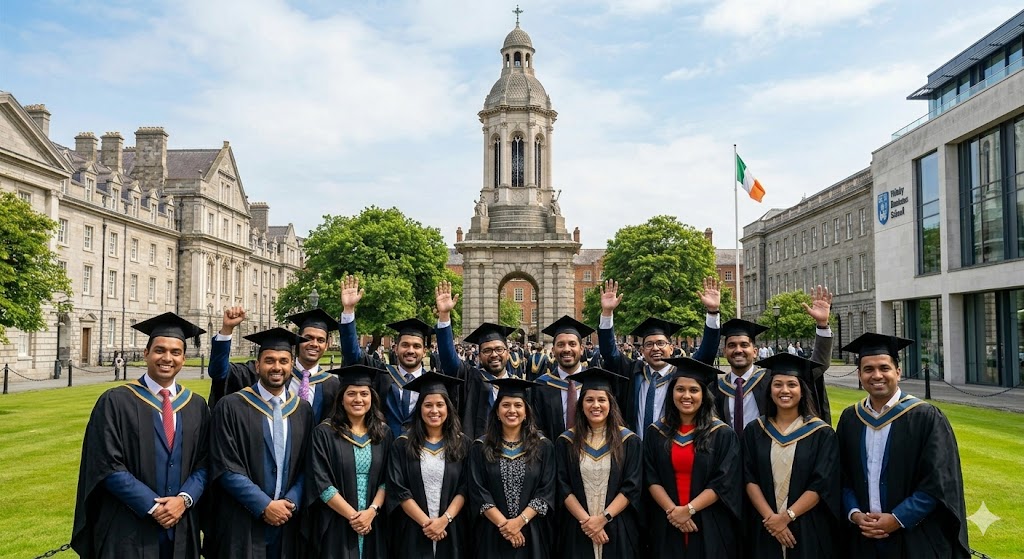
365 days. That is exactly how long it takes to go from a mid-level professional in India to a globally sought-after management graduate in the “Silicon Valley of Europe.” You won’t be spending two years writing theoretical papers. Instead, a 12-month MBA in Ireland drops you directly into live consulting projects with companies like Hubspot, Accenture, and Microsoft. If you want to spend less time in a classroom and more time negotiating your starting salary in Euros, you are looking at the right country.
If you are an Indian student looking to fast-track your career, gain global exposure, and secure a high return on investment (ROI) without spending two full years out of the workforce, Ireland might just be your perfect match. Unlike the traditional two-year MBA programs in the US or Canada, an MBA in Ireland is typically an intense, action-packed one-year journey.
But is Ireland good for an MBA? How much will it cost? What are the entry requirements? As a study abroad advisor who has helped countless students turn their global career dreams into reality, I’ve put together this comprehensive, fluff-free guide to answer all your questions.
Let’s dive into everything you need to know about pursuing an MBA in the Emerald Isle.
Why Choose Ireland for Your MBA?
Before we talk about colleges and costs, we need to answer the big question: Why Ireland?
1. The “Silicon Valley of Europe”: Ireland is the European hub for over 1,000 multinational companies, including Google, Apple, Meta, Microsoft, Pfizer, and Johnson & Johnson. This means incredible networking opportunities and a direct pipeline to global giants.
2. Post-Study Work Visa: Ireland offers a highly attractive 2-year stay-back visa (under the Third Level Graduate Scheme) for international students completing a Master’s degree (Level 9). This gives you ample time to secure a full-time job and transition to a Critical Skills Employment Permit.
3. One-Year Programs: Time is money. Most MBA programs in Ireland are completed in 12 months. You save on a second year of tuition and living expenses, and you re-enter the job market faster.
4. English-Speaking Nation: As an English-speaking country, transitioning into the culture, academics, and corporate environment is incredibly smooth for Indian students.
5. Booming Economy: Ireland consistently boasts one of the fastest-growing economies in the Eurozone, meaning a healthy job market for highly skilled management graduates.
Top MBA Colleges in Ireland
When researching the top MBA colleges in Ireland, you’ll find institutions that consistently rank high globally for employability, alumni outcomes, and academic rigor. Here are the top contenders:
1. University College Dublin (UCD) – Michael Smurfit Graduate Business School
- Location: Dublin
- Duration: 12 Months
- USP: UCD Smurfit holds the prestigious “Triple Crown” of accreditation (AACSB, AMBA, EQUIS)—an honor shared by less than 1% of business schools worldwide. It consistently ranks in the Financial Times Global MBA Top 100.
- Vibe: Highly competitive, globally recognized, with a massive international alumni network.
2. Trinity College Dublin (TCD) – Trinity Business School
- Location: Dublin
- Duration: 12 Months
- USP: Trinity is Ireland’s oldest and most prestigious university. Their MBA heavily focuses on live, project-based learning. You won’t just sit in lectures; you will solve real-world problems for real companies.
- Vibe: Historic, prestigious, with a strong focus on sustainable business and entrepreneurship.
3. Dublin City University (DCU) – DCU Business School
- Location: Dublin
- Duration: 12 to 24 Months (depending on the track)
- USP: DCU is highly renowned for its deep industry connections and focus on innovation, digital transformation, and leadership.
- Vibe: Modern, tech-forward, and incredibly practical.
4. University of Limerick (UL) – Kemmy Business School
- Location: Limerick
- Duration: 12 Months
- USP: If you want a top-tier education with a slightly lower cost of living compared to Dublin, UL is a fantastic choice. It boasts state-of-the-art facilities and a highly practical aviation and corporate focus.
- Vibe: Community-driven, great campus life, excellent ROI.
(Note: There are also highly affordable options like Dublin Business School (DBS) and National College of Ireland (NCI) for students with stricter budget constraints.)
Cost of MBA in Ireland for Indian Students
Let’s talk numbers. Budgeting is often the most stressful part of planning your study abroad journey. The cost of an MBA in Ireland for Indian students can be broken down into two main categories: tuition and living expenses.
1. Tuition Fees
- Top-Tier Universities (UCD, Trinity): €35,000 – €37,000 (Approx. ₹31 Lakhs – ₹33 Lakhs)
- Mid-Tier Universities (DCU, UL, UG): €14,000 – €18,000 (Approx. ₹12 Lakhs – ₹16 Lakhs)
- Private Colleges (DBS, NCI): €12,000 – €15,000 (Approx. ₹10 Lakhs – ₹13.5 Lakhs)
2. Living Expenses
Living in Ireland, particularly in Dublin, can be expensive. On average, you should budget between €10,000 to €15,000 per year (₹9 Lakhs to ₹13.5 Lakhs) for accommodation, food, utilities, and transport. Cities like Limerick, Cork, and Galway are generally 15-20% cheaper than Dublin.
Advisor’s Tip for Managing Costs:
International students in Ireland are legally allowed to work 20 hours per week during the semester and 40 hours per week during scheduled holidays. Earning the minimum wage (around €12.70/hour) can help you comfortably cover your groceries, transport, and utilities!
Eligibility for MBA in Ireland
What does it take to get in? The study MBA in Ireland requirements vary slightly from college to college, but here is the standard checklist:
- Academic Record: A Bachelor’s degree from a recognized Indian university with a minimum score of 60% (First Class).
- Work Experience: This is crucial. Unlike typical MSc Management programs, an MBA requires practical context. Top universities like UCD and Trinity require a minimum of 3 to 5 years of professional work experience. (If you are a fresher, look into MSc in Management programs instead!).
- English Proficiency: * IELTS: Minimum 6.5 (with no band less than 6.0). Some top universities require a 7.0.
- TOEFL / PTE: Accepted equivalents (e.g., PTE score of 63+).
- GMAT/GRE: Top schools like UCD Smurfit and Trinity Business School usually require a competitive GMAT score (typically 600+). However, many universities (like DCU, UL, and private colleges) offer GMAT waivers based on extensive work experience or do not require it at all.
- Documentation: A compelling Statement of Purpose (SOP), 2 Letters of Recommendation (professional preferred), and an updated, metric-driven CV.
MBA Specializations in Demand
A general MBA is great, but specializing makes you a magnet for recruiters. Because of Ireland’s unique economic landscape, certain specializations offer a faster track to high-paying jobs:
- MBA in Data Analytics / Tech Management: With tech giants dominating Dublin, bridging the gap between management and big data is incredibly lucrative.
- MBA in Finance: Dublin is a major European financial hub (IFSC), hosting banks like Citi, State Street, and Barclays.
- MBA in Supply Chain Management: Post-Brexit, Ireland has become a critical logistics hub for European and global trade.
- MBA in Digital Marketing: Perfect for the booming e-commerce and tech sectors.
MBA Salary in Ireland (The ROI Section)
Let’s get to the most exciting part—your return on investment. The MBA salary in Ireland is highly competitive, especially when you factor in the 1-year duration of the course.
- Average Starting Salary: MBA graduates in Ireland typically start between €55,000 to €85,000 per year (Approx. ₹49 Lakhs to ₹76 Lakhs), depending on their prior experience and the university’s reputation.
- High-Paying Roles: * Senior Product Manager: €80,000+
- Management Consultant: €70,000 – €90,000+
- Finance Director / Manager: €85,000+
- Supply Chain Director: €75,000+
The ROI Reality Check: If you spend ₹45 Lakhs total (tuition + living) at a top school and graduate into a €70,000 (₹63 Lakhs) job, you can realistically recoup your entire investment within 1.5 to 2 years of working in Ireland. That is an exceptional ROI compared to US programs that cost upwards of ₹1 Crore.
Job Opportunities & Career Scope
The career scope after an MBA in Ireland is vast. The presence of multinational headquarters means that these companies don’t just have back-offices in Ireland; they have their European strategy, finance, and marketing hubs there.
Top Recruiters for MBA Graduates:
- Tech: Google, Amazon, Meta, Microsoft, Apple, Hubspot.
- Consulting & Finance: PwC, Deloitte, EY, KPMG, Accenture, Bank of America.
- Pharma & MedTech: Pfizer, Novartis, Medtronic, Boston Scientific.
Thanks to the 2-year post-study work visa, you have ample time to network, attend career fairs, and secure a role that sponsors your Critical Skills Visa, paving the way for permanent residency if you choose to stay.
Scholarships & Financial Aid
You don’t have to bear the cost alone. Irish universities and the government love attracting top Indian talent.
- Government of Ireland International Education Scholarship (GOI-IES): Offers a full tuition fee waiver plus a €10,000 stipend for one year of study. Highly competitive!
- University-Specific Scholarships: * UCD offers the Sir Michael Smurfit MBA Scholarship (up to 100% fee waiver for exceptional candidates) and Regional Scholarships for Indian students.
- Trinity offers MBA Merit Scholarships ranging from €5,000 to full tuition.
- Early Bird Discounts: Many private and mid-tier colleges offer €1,000 to €3,000 off your tuition just for accepting your offer early.
Tip: Apply early! Scholarship deadlines are usually between February and April for the September intake.
How to Apply for an MBA in Ireland (Step-by-Step)
Don’t let the process overwhelm you. Here is your actionable roadmap:
- Step 1: Shortlist (August – October): Research universities based on your budget, GMAT score, and career goals.
- Step 2: Test Prep (September – November): Take your IELTS/TOEFL and GMAT (if required).
- Step 3: Documentation (November – December): Draft a stellar SOP highlighting your leadership experience. Gather your professional LORs.
- Step 4: Apply (January – March): Submit applications via university portals. (Early applicants have a massive advantage for scholarships!).
- Step 5: Interviews (February – April): Top MBA programs will invite you for a video interview to assess your communication skills and cultural fit.
- Step 6: Accept & Pay Deposit (April – May): Secure your seat by paying the initial deposit.
- Step 7: Visa & Accommodation (June – August): Apply for your Irish Student Visa (Stamp 2) and start the hunt for student housing.
- Step 8: Fly to Ireland (September)!
Challenges Students Might Face (And How to Beat Them)
As a mentor, I believe in giving you the full picture—no sugarcoating.
- The Housing Crisis: Finding accommodation in Dublin is notoriously difficult and expensive right now.
- Solution: Start looking for the exact day you accept your university offer. Use university-managed accommodations or verified platforms like AmberStudent or Yugo.
- The 12-Month Hustle: Compressing an MBA into one year means the coursework is intense. You will be juggling assignments, exams, and job hunting simultaneously.
- Solution: Time management is your best friend. Treat the MBA like a 9-to-5 job.
- Networking is Mandatory: Irish work culture heavily relies on referrals and networking. Just applying online won’t cut it.
- Solution: Utilize LinkedIn aggressively. Go to every alumni mixer, tech meetup, and career fair your university hosts. Buy people coffee.
FAQs
1. Is the GMAT mandatory for an MBA in Ireland?
No, it’s not always required. Ultra-competitive schools like UCD ask for a 600+ score, but many top universities (like DCU or UL) will happily waive the GMAT if you have 3 to 5 years of solid managerial experience.
2. Can Indian students get scholarships for an MBA in Ireland?
Absolutely. You can secure anything from a €1,000 early-bird discount to a full ride. The government’s GOI-IES scholarship covers full tuition plus a €10,000 stipend, and universities offer their own merit awards. Apply early, as funds dry up quickly.
3. Can I bring my spouse with me during my MBA in Ireland?
As a student on a standard Stamp 2 visa, you generally cannot bring dependents. However, once you graduate and secure your Critical Skills Employment Permit, your spouse can legally join you and work immediately.
4. How much work experience is needed for an MBA in Ireland?
The gold standard is 3 to 5 years of professional experience. If you only have 1 or 2 years, look into an MSc in Management instead. It offers identical visa benefits and a similar career path without the strict experience hurdle.
Conclusion: Your Global Career Awaits
Pursuing an MBA in Ireland is more than just an academic decision; it is a strategic career move. You get world-class education, access to the European market, a booming tech and finance ecosystem, and a clear pathway to work abroad—all at a fraction of the time and cost of an American MBA.
Yes, it requires investment, hard work, and the courage to step out of your comfort zone. But the reward? A globally recognized profile and a career trajectory you once only dreamed of.
Are you ready to take the leap?
Don’t navigate this complex journey alone. At Eleevate Overseas, our expert study abroad advisors specialize in matching Indian professionals with the perfect MBA programs in Ireland. From shortlisting universities and securing GMAT waivers, to polishing your SOP and guiding you through the Irish visa process—we are with you every step of the way.
Book your FREE 1-on-1 Profile Evaluation today and let’s map out your journey to the boardrooms of Dublin!