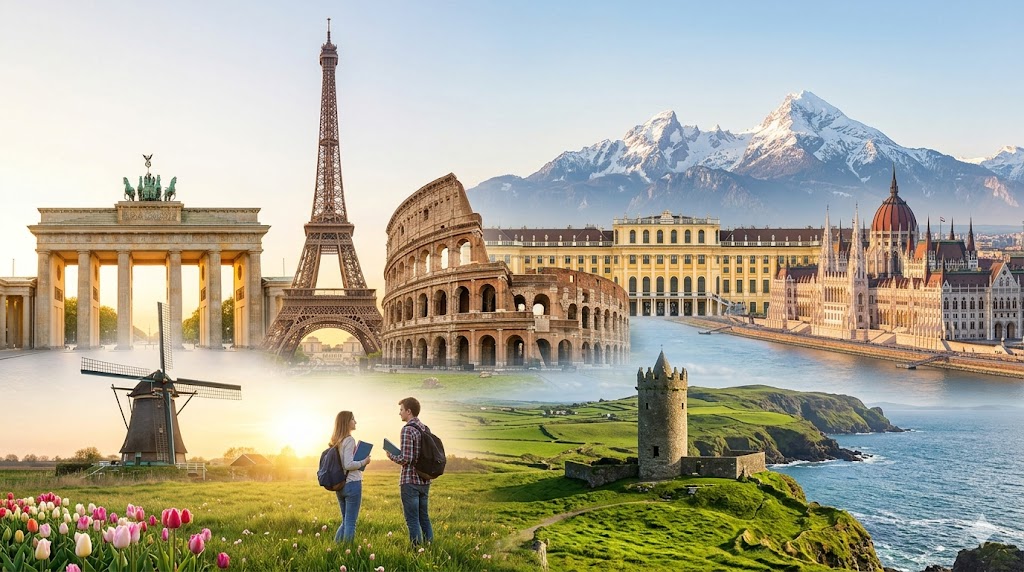
The old way of studying abroad was purely about the experience—taking some photos, learning a bit of culture, and heading back. The new way is about strategic career positioning. Today’s top students aren’t just looking for a degree; they are looking for a launchpad. They want to know the best European countries for international students that offer not just world-class academics, but a red carpet to long-term employment, permanent residency, and a high-paying global career.
Why is Europe the ultimate destination right now? We are witnessing a massive demographic shift. Across the continent, aging populations and rapid technological advancements have created a massive talent deficit. European governments and corporations are practically begging for young, highly skilled, globally-minded talent to fill the gaps in tech, green energy, finance, and engineering. They don’t just want you to study in Europe; they desperately want you to stay.
But not all countries are created equal when it comes to ROI (Return on Investment). You need to know exactly which nations have the most generous post-study work visa Europe policies, where the hidden industry hubs are, and how to maximize your earning potential against your cost of living.
Let’s dive deep into the economic realities. Here is your definitive, thought-leadership guide to the absolute best countries to study, work, and thrive in Europe.
1. Germany: The Industrial Powerhouse with a Talent Deficit
If there is one country that has perfected the bridge between academia and industry, it is Germany. Known globally for its engineering prowess, Germany is undergoing a massive digital transformation, creating an unprecedented demand for international talent.
Why Study in Germany?
Germany is famously home to some of the most prestigious European universities for international students, particularly the TU9 (a coalition of the leading institutes of technology). But the real draw? Public universities charge little to zero tuition fees, even for non-EU students. You are getting an Ivy League-caliber education in engineering, data science, or business for the cost of a semester’s administrative fee. The education style is highly pragmatic, heavily integrating internships and working student (Werkstudent) roles into the curriculum.
The Job Market & Industries
Germany is not just about cars anymore. While the automotive sector (Volkswagen, BMW, Mercedes) is furiously hiring for EV (Electric Vehicle) battery specialists and autonomous driving software engineers, the real hidden goldmine is the Mittelstand—the medium-sized, family-owned tech and manufacturing companies that form the backbone of the German economy. Furthermore, Berlin has cemented itself as the startup capital of Europe. If you are looking for international student jobs in Europe in fields like Artificial Intelligence, Industry 4.0, FinTech, or Green Tech, Germany’s job market is practically shouting your name.
Post-Study Work Visa Rules
Germany offers one of the most generous immigration pathways in the world. Upon graduation, international students are entitled to an 18-month job seeker visa. During this year and a half, you can work any job to support yourself while you look for a position related to your degree. Once you secure a skilled job, transitioning to an EU Blue Card or a standard work permit is a streamlined process.
Cost of Living & ROI
Because tuition is practically non-existent at public universities, your ROI is astronomical. Your primary expenses will be living costs, which average around €900 to €1,200 per month depending on the city (Munich is expensive; Leipzig is cheap). When you factor in starting salaries for STEM graduates (often €50,000 – €60,000+), the math makes Germany an unbeatable investment.
2. Ireland: The “Silicon Valley” of Europe
With the UK complicating its post-Brexit visa rules, Ireland has swooped in to become the premier English-speaking destination for international students looking to crack into Big Tech and pharmaceuticals.
Why Study in Ireland?
Ireland boasts a highly respected, research-driven education system with Trinity College Dublin and University College Dublin leading the pack. The classroom culture is highly interactive, collaborative, and deeply connected to global industry standards. Because English is the primary language, the friction of cultural integration and job hunting is drastically reduced compared to mainland Europe.
The Job Market & Industries
Look at the skyline of Dublin, and you will see the logos of the modern global economy. Google, Apple, Meta, Microsoft, and X all have their European headquarters here. But it’s not just tech. Ireland is a global juggernaut in Pharmaceuticals and MedTech, hosting manufacturing and R&D hubs for Pfizer, Johnson & Johnson, and Novartis. If you are studying computer science, data analytics, pharmacology, or international business, Ireland offers direct access to the most lucrative international student jobs in Europe.
Post-Study Work Visa Rules
Ireland’s Third Level Graduate Scheme is incredibly attractive. Bachelor’s degree graduates can stay for 12 months, while Master’s and PhD graduates are granted a 24-month post-study work visa. This gives you two full years to network, intern, and secure critical skills employment.
Cost of Living & ROI
Let’s be candid: Dublin is experiencing a housing crisis, making rent expensive. You should budget €1,500 to €2,000 per month for living expenses in the capital. However, the ROI is justified by the sheer concentration of high-paying multinational roles. If you land a job at a top-tier tech or pharma firm, your career trajectory and earning potential will easily offset the initial living costs.
3. France: The Renaissance of Tech and Luxury
For decades, France was viewed primarily through the lens of art, history, and luxury. Today, under aggressive government initiatives like “La French Tech,” France has rapidly evolved into a hyper-modern hub for artificial intelligence, aerospace, and sustainable engineering.
Why Study in France?
France offers an elite, highly rigorous academic structure, particularly through its Grandes Écoles—specialized institutions that produce the country’s top engineers, business leaders, and politicians. French business schools (like HEC Paris, INSEAD, and ESCP) consistently rank at the very top globally. The government heavily subsidizes higher education, making public universities very affordable, and the country actively courts international talent to study in Europe through numerous scholarships like the Eiffel Excellence program.
The Job Market & Industries
While the luxury management and fashion sectors remain undisputed global leaders (LVMH, Kering, Chanel), the real growth is in Deep Tech. Paris is currently in an arms race with London to become the AI capital of Europe, fueled by massive investments and homegrown unicorns like Mistral AI. Additionally, the aerospace industry in Toulouse (Airbus) and the renewable energy sector are aggressively recruiting international STEM talent.
Post-Study Work Visa Rules
France is highly favorable to postgraduate students. If you complete a Master’s degree (or equivalent), you are eligible for a 12-month Temporary Resident Permit (APS), which can often be extended for another 12 months depending on your home country’s bilateral agreements. During this time, you can work up to 60% of the legal workweek until you find full-time employment related to your studies, at which point you switch to a full work visa.
Cost of Living & ROI
Outside of central Paris, France is surprisingly affordable. Cities like Lyon, Lille, and Toulouse offer a fantastic quality of life for around €800 to €1,200 per month. The ROI is incredibly strong, especially for graduates of business and engineering schools, who are highly sought after by French multinationals.
4. The Netherlands: The Progressive Hub of Commerce and Innovation
The Netherlands punches far above its weight class. It is a tiny country with a massive global footprint, renowned for its open-minded culture, stunning infrastructure, and relentless innovation.
Why Study in the Netherlands?
Dutch universities utilize a Problem-Based Learning (PBL) methodology. You aren’t just sitting in a lecture hall; you are actively solving real-world corporate problems in small teams. Furthermore, the Netherlands offers the largest number of English-taught programs in continental Europe. You can easily navigate the entire country, both academically and socially, without speaking a word of Dutch.
The Job Market & Industries
The Dutch economy is incredibly diverse. You have the agro-food tech sector centered around Wageningen, the massive logistics and maritime trade hub in Rotterdam, and a booming FinTech and startup ecosystem in Amsterdam. But the crown jewel is ASML, the world’s most important semiconductor equipment manufacturer, located in Eindhoven (the “Brainport” of Europe). They, along with companies like Philips and Adyen, are starved for engineers, supply chain experts, and data analysts.
Post-Study Work Visa Rules
The Netherlands offers the highly coveted Orientation Year (Zoekjaar) Visa. This allows you to stay for up to 12 months after graduation to find a job or start your own business. The brilliant part of this visa is that it gives you free access to the Dutch labor market without any restrictions—employers don’t need to sponsor a work permit for you during this year, making you incredibly hireable.
Cost of Living & ROI
Tuition is moderate (usually €8,000 to €15,000 per year for non-EU students). Living costs range from €1,000 to €1,500. The ROI here is built on the high quality of life, the 30% tax ruling facility (a massive tax break for highly skilled migrants), and the seamless transition into English-speaking corporate roles.
5. Italy: The Design, Tech, and Manufacturing Renaissance
Often overlooked in favor of its northern neighbors for post-grad careers, Italy is rapidly changing its narrative. As the third-largest economy in the EU, Italy is blending its historic legacy of craftsmanship with modern technology.
Why Study in Italy?
Italy offers a spectacular blend of high-quality education and unparalleled cultural immersion. Institutions like Politecnico di Milano and Bocconi University are global heavyweights in engineering, architecture, and business. Furthermore, Italy is fiercely competitive when it comes to tuition, making it one of the cheapest countries to study in Europe relative to the prestige of its institutions. Regional scholarships often cover tuition and provide stipends based on financial need, regardless of nationality.
The Job Market & Industries
Beyond the obvious giants of Fashion and Luxury (Gucci, Prada, Armani), Italy is a massive manufacturing and engineering powerhouse. The “Motor Valley” in Emilia-Romagna (Ferrari, Lamborghini, Ducati) is a dream for mechanical and automotive engineers. Milan is the undisputed financial and commercial capital, with a rapidly expanding tech and startup scene heavily supported by venture capital looking to build Southern Europe’s next unicorns.
Post-Study Work Visa Rules
Italy allows non-EU students who have completed a Master’s or PhD to apply for a Permesso di Soggiorno per Attesa Occupazione (Residence Permit for Pending Employment), which allows you to stay in Italy for 12 months after graduation to find a job or start a business.
Cost of Living & ROI
This is where Italy truly shines. Except for central Milan, the cost of living in Italy is remarkably lower than in Northern Europe. You can live very comfortably in cities like Turin, Bologna, or Padua for €700 to €1,000 per month. Lower tuition and lower living costs equal rapid ROI, especially as Italian companies begin globalizing their workforces.
The Hidden Gems: Austria & Hungary
If you want to maximize your ROI, avoid the massive crowds, and still get access to the Schengen Zone’s vibrant economy, you must look at Central Europe.
Austria is quietly one of the most prosperous nations in Europe. Vienna consistently ranks as the most livable city in the world. It offers a thriving hub for biotechnology, IT, and international relations (hosting the UN and OPEC). The Red-White-Red Card system makes it increasingly easy for graduates of Austrian universities to transition into the workforce, particularly if their skills are in shortage.
Hungary, on the other hand, is rapidly becoming one of the premier affordable countries to study in Europe with a shockingly high upside. Budapest is a rising star in the European tech scene, attracting massive foreign direct investment from global automotive and tech companies looking for highly skilled, cost-effective talent. Universities here are incredibly affordable, and the cost of living is a fraction of what it is in the UK or Ireland. International students in Hungary have excellent opportunities to secure roles in multinational corporations (like Bosch, Morgan Stanley, and IBM) who have set up major regional service and R&D centers in Budapest.
How to Make Yourself Employable Before You Graduate
Knowing the best European countries for international students is only 20% of the battle. The other 80% is what you do from the moment you step foot on campus. You cannot wait until your final semester to think about your post-study work visa in Europe.
To guarantee your transition from international student to highly-paid global professional, you must adopt an “Employability-First” mindset:
1. Learn the Local Language (Yes, Even if Your Program is in English)
This is the single biggest mistake international students make. Yes, you can survive in Amsterdam, Berlin, or Stockholm with just English. But if you want to be promoted, if you want to network at industry events, and if you want access to 100% of the job market instead of just the 20% that operates in English, you must learn the local language. Treat language learning as a core credit of your degree. It shows employers cultural respect and a long-term commitment to their country.
2. Leverage the “Working Student” Culture
In Europe, having a perfectly formatted CV with zero actual work experience is a red flag. European employers value practical application over theoretical perfection. Take advantage of part-time work rights. In Germany, Werkstudent roles are the ultimate pipeline to full-time jobs. These aren’t barista jobs; they are 20-hour-a-week roles in your field of study. You build local references, understand European corporate culture, and effectively undergo a year-long interview.
3. Optimize for the “Hidden Job Market”
Over 60% of corporate jobs in Europe are never posted on LinkedIn or Indeed. They are filled through internal referrals, university partnerships, and networking. You must be visible. Attend industry trade fairs (like Web Summit in Lisbon, IFA in Berlin, or VivaTech in Paris). Engage with your professors—many of them are active consultants for major corporations. Optimize your LinkedIn profile for the specific country you are in, and don’t be afraid to send cold messages to alumni from your university who are working at your target companies.
4. Understand the Visa Leverage
When you sit down for an interview, the HR manager might be hesitant, thinking they have to go through a complex sponsorship process to hire you. You must be the expert on your visa. You need to confidently say, “Because I am graduating from a local university, I am automatically entitled to an 18-month job seeker visa, which gives me full unrestricted working rights. There is no sponsorship required for you to hire me today.” Remove the friction, and you become instantly more hirable.
FAQs
1. Which of the Best European countries offer the highest ROI?
Germany and Italy are the heavy hitters here. Germany offers Ivy-League-level STEM degrees for practically zero tuition, while Italy pairs elite universities with much lower living costs than Northern Europe. Both lead straight into strong job markets.
2. Do I actually need to speak the local language in the Best European countries?
If you want the best jobs, yes. While the Best European countries like the Netherlands and Germany have plenty of English-speaking roles, learning the local language is your unfair advantage. It proves your commitment and makes you highly promotable.
3. How easy is it to get a post-study work visa in the Best European countries?
Governments in the Best European countries want you to stay. Germany gives you 18 months, Ireland up to 24 months, and the Netherlands gives a 12-month unrestricted pass. Getting the visa is easy; the hustle is networking and proving your value during that grace period.
4. How do I choose between the Best European countries for my specific degree?
Match your degree to the country’s economic engine. For Big Tech and Pharma, look at Ireland. For Automotive and Green Engineering, Germany is unmatched. For AI and Aerospace, aim for France. The Best European countries for you depend entirely on your career goals, which is why a 1-on-1 counseling strategy is crucial.
The Final Verdict: Your Global Career Awaits
The narrative around international education has fundamentally shifted. It is no longer a luxury; it is a strategic career investment. The best European countries for international students are not just offering degrees; they are offering partnerships. They provide the infrastructure, the industries, and the post-study work visa Europe pathways. You simply have to provide the ambition and the execution.
Whether you are drawn to the engineering powerhouses of Germany, the tech dominance of Ireland, the deep-tech renaissance of France, the progressive commerce of the Netherlands, the vibrant growth of Italy, or the incredible ROI of hidden gems like Austria and Hungary—Europe is open for business, and it is looking for you.
Ready to elevate your global career? The journey from an ambitious student to a successful international professional requires expert guidance, precise university selection, and a flawless visa strategy. We don’t just process applications; we engineer careers.If you are ready to stop dreaming and start planning your European success story, connect with us today. Let’s find the perfect destination, unlock those hidden scholarships, and set you up for a high-paying international career. The world is waiting—let’s go get it.